


The following is a response to Catalina Ruiz-Navarro’s column, ‘Response to a Trans-Exclusionary Reader.’ This is the longer version I posted on Substack on May 14th. I submitted it to El Espectador, which retains full editorial authority over its letters section and published a shortened version on May 16th.
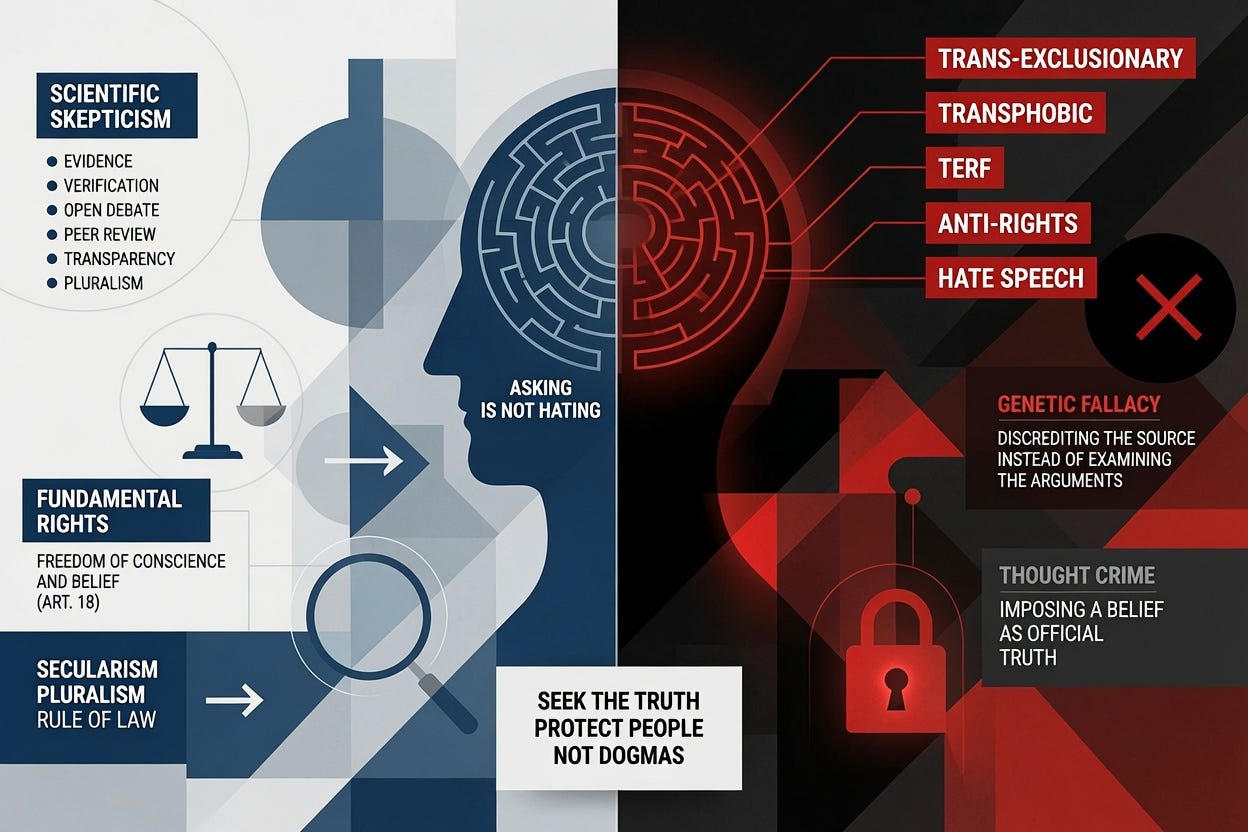
A few of the columnist’s rhetorical strategies are worth examining. First, the repeated use of labels is striking: the columnist resorts to terms such as “trans-exclusionary”, “transphobic”, “anti-rights”, or “hate speech”, to which we could add “TERF” (Trans-Exclusionary Radical Feminist), which serve to discredit the opponent and evade substantive issues.
These labels share a logical flaw of circular reasoning: anyone who denies gender identity is trans-exclusionary. Denying gender identity is condemnable because it is a “scientific truth.” It is a scientific truth because those who experience it acknowledge being a different sex than the one they were born. But no verifiable evidence is offered for this concept to be adopted as a universal truth. It starts from a premise that is neither explained nor demonstrated: anyone who does not accept it is labeled trans-exclusionary. And so the circle closes on itself: the conclusion was already contained in the premise.
Demanding scientific evidence for a biological claim is not exclusion: it’s what’s done with any claim before accepting it as true. And if it can’t be proven, the concept functions as a belief.

Why is it important to clarify whether the theory of sex reassignment is a fact or a belief? If it is a demonstrable fact, it would be enforceable against others, and it would be legitimate to design laws, medical protocols, and public policies with mandatory application. But if it is a belief, its constitutional status is radically different: a state that adopts a belief as official would cease to be secular.
Demanding that the concept of gender identity replace biological sex in contexts where sex matters, such as medicine, sports, civil registration, statistics, prisons, women’s spaces, language, and education, is an imposition that turns dissent into what Orwell called thoughtcrime.

Believing in gender identity as an inner reality is a personal right, but it is worth noting that it is constitutionally protected under freedom of religion and conscience (Article 18 of the Colombian Constitution). Labeling conceptual disagreement as hate speech (and criminalizing it) and presenting skepticism as an existential threat is, in practice, similar to reinstating blasphemy laws.
Colombia abandoned the confessional model with the 1991 Constitution, whose first article enshrines secularism and pluralism precisely so that no belief could be imposed as an official truth enforceable against everyone. These kinds of laws do not protect people but dogmas: they shield beliefs from criticism and turn dissent into a moral failing. Perhaps this explains why the critical voices that exist come mostly from religious convictions and why secular voices are scarce. In a secular state, beliefs are a private matter, and this debate should also be waged from the standpoint of scientific skepticism — this is the tool that states governed by the rule of law have used to validate truths of general application. What no one seems to realize is that gender identity, as it is currently being demanded, is exactly that: an article of faith.
Freedom of conscience protects both the right to believe and the right not to believe what is not considered true. The label of trans-exclusionary attacks this second dimension: it is equivalent to calling someone who does not adopt that dogma a heretic.
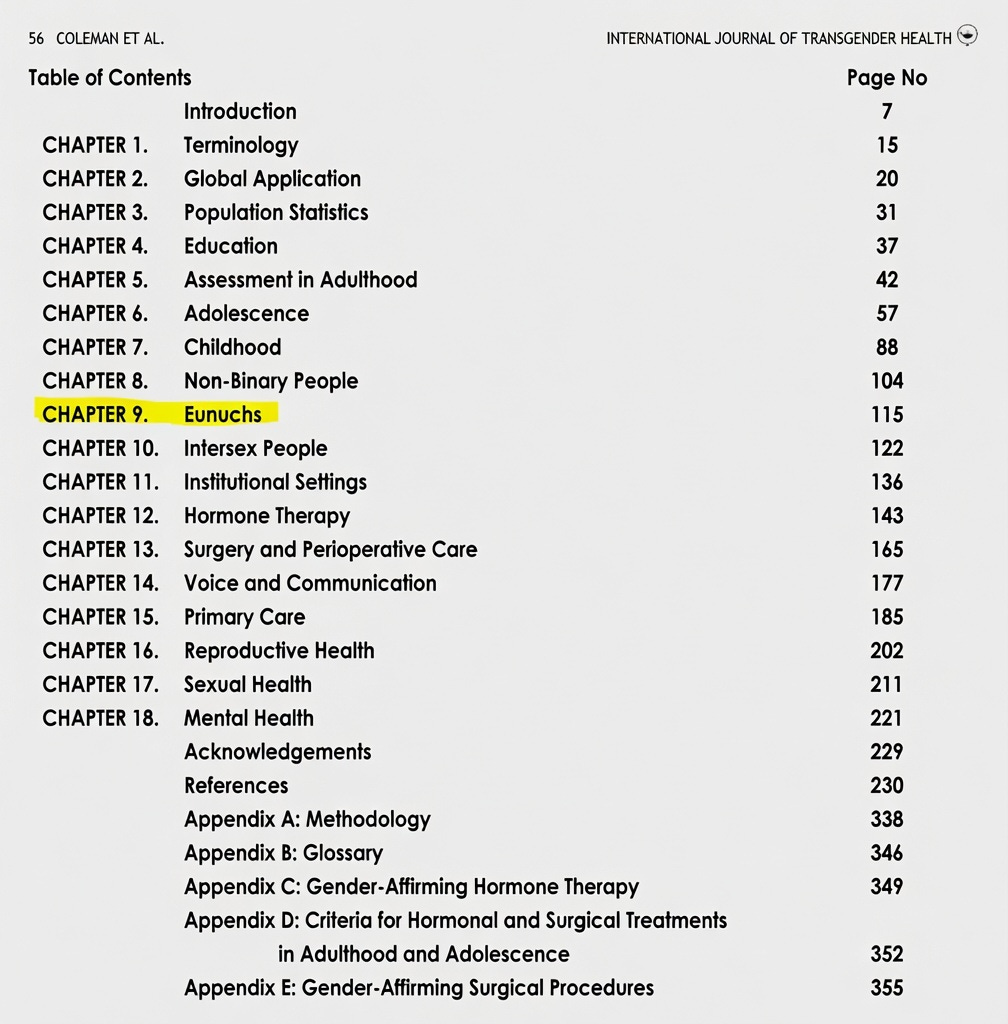
The column equates cosmetic surgeries with gender-affirming procedures, omitting the fact that, according to leaked internal communications from the World Organization for Transgender Health (WPATH) itself and statements from its former president, Marci Bowers, these procedures can have irreversible consequences such as sterility and anorgasmia. Chapter 9 of its Standards of Care, titled “Eunuchs,” justifies the voluntary castration of men without sufficient medical evidence.
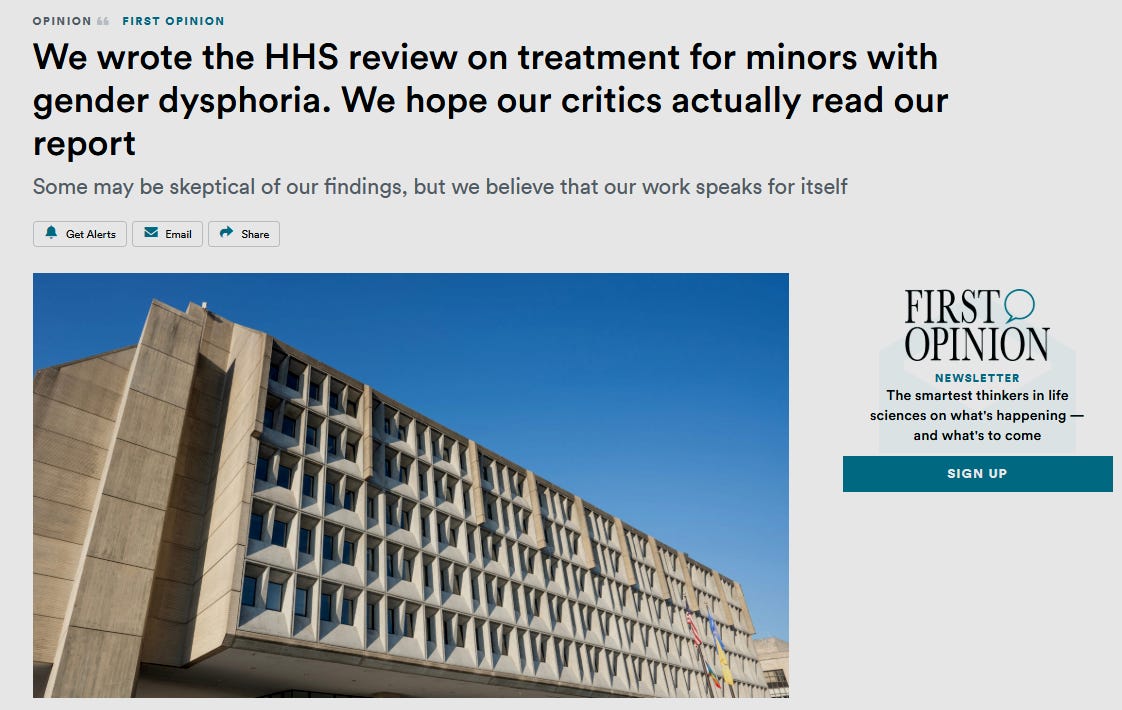
The column relies on a systematic genetic fallacy: any source that questions gender identity is morally labeled and disqualified without a single argument being examined. The case of the HHS report is illustrative. The columnist dismisses it by appealing to who commissioned it, not to what it says. The nine authors described themselves as a politically diverse group, mostly liberals and Democratic Party sympathizers, with a shared commitment to evidence-based medicine. They include Alex Byrne, a philosopher at MIT; Kathleen McDeavitt, a physician at Baylor College of Medicine; Leor Sapir, a researcher at the Manhattan Institute; and Evgenia Abbruzzese, of the Society for Evidence-Based Gender Medicine.
Anticipating this pattern, the authors themselves titled their public response to critics with a phrase that applies precisely to this case: “We hope our critics actually read our report.” The report rests on a substantial evidentiary base: it analyzed 17 previous systematic reviews, many conducted in Europe. Systematic reviews represent the highest level of the scientific evidence hierarchy, rigorously synthesizing all available studies on a topic and reducing the potential for bias in any single research study.
The report found that the overall quality of evidence regarding the effects of these interventions is “very low,” while documented risks include infertility, sexual dysfunction, reduced bone density, and adverse cognitive impact. Methodology experts from the Centre for Evidence-Based Medicine in Belgium rated its methodology as “robust” and “transparent .” Before its final publication, the report underwent a peer-review process in which critics had the opportunity to raise objections; each objection received a documented response from the authors, which can be found on the HHS website.
In contrast, the sources that support the gender identity theory defended by the columnist seem to be exempt from the rigorous scrutiny that medical ethics requires to endorse potentially irreversible procedures, especially in minors.
It’s worth asking: Is there any critical evaluation of precedents like the Reimer case, in which John Money, the originator of the concept of gender identity, subjected a minor and his twin brother to experiments and sexual abuse documented by John Colapinto? Both ended up committing suicide. Or what about his statements to Paidika, a pro-pedophilia publication, in which he didn’t consider an erotic relationship between an adult and a ten- or eleven-year-old child to be pathological?

I believe it is important for the Colombian public to know this background to form a complete picture of a debate that has, up until now, been presented with significant bias.
Let the reader judge which evidence is more convincing.
Javier Rodriguez is a Colombian researcher and, unintentionally, an independent journalist. He offers critical, secular perspectives and analysis on gender identity, grounded in verifiable evidence and reputable sources.
Genspect publishes a variety of authors with different perspectives. Any opinions expressed in this article are the author’s and do not necessarily reflect Genspect’s official position. For more on Genspect, visit our FAQs.
