

A Sociological Perspective
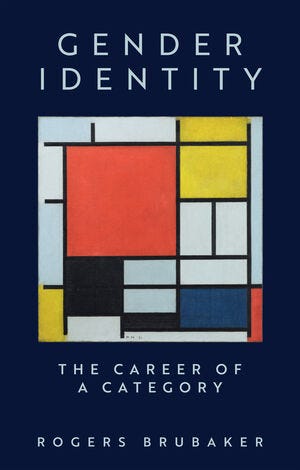
The book Gender Identity: The Career of a Category, by Rogers Brubaker (Polity, 2026) is a work of sociology. Its subject is gender identity, a relatively new concept that seeks to overshadow the traditional biological concept of sex.
The central idea of the book is to consider gender identity not as a thing in itself, but as a social category. That is, the focus is not on what it is, but on what it does. The book is scholarly and at the same time an attractive read. It is the best overview to date about what is going on in the gender world.
This approach contrasts with that of the valuable books by philosophers Kathleen Stock (Material Girls) and Alex Byrne (Trouble with Gender). They attempt to reveal what could be meant by ‘gender identity’, but they encounter complicating issues.
A first issue is the ambiguity in the word ‘gender’. It can mean sex in the usual meaning of male/female. It can also mean social structure and culture associated with sex. Finally, it can mean gender identity, which is purported to be an inner sense having something to do with gender. But is this inner sense about sex, or about culture associated with sex?
Second, is this sense that of an innate “true sex”, one that can differ from natal sex? Or is it a subjective sense of self, perhaps with a cultural manifestation? Fortunately, the sociological approach does not depend on settling such questions.
Brubaker mentions these difficulties. He points to a possible “strong definition” and “weak definition” of gender identity:
On the strong definition that crystallized in connection with midcentury medicalized understandings of trans-sexualism, gender identity is a foundational and immutable identification as and with one sex or the other. On the weak definitions that have proliferated in recent years, it is every individual’s own experience of gender, which may or may not be defined in relation to binary sex categories. (p. 8)
The advantage of his approach is that he does not have to take a stand on what gender identity is; he can simply describe actions taken under its scope.
Gender Identity as a Social Category
The notion of social category applies not only to gender identity, but to other categories, such as sex, sexual orientation, race, ethnicity, nation, or religion. Brubaker lists some ways these categories work. The ways can be:
Performative. Individuals and institutions take action on the basis of the category.
Productive. The category can not only designate, but bring into being types of individuals.
Interactive. The interaction of people with the category may mutate it or even produce new categories.
Regulative. The category may introduce discipline or accountability in its members.
In the case of gender identity, the performative aspects are well known, ranging from changes in legal status to medical interventions. Also: “people can draw on the category to make sense of how they feel, to articulate who they are, and to explore and specify where they fit in the prevailing taxonomy of identities.” (p. 15)
One aspect of the productive aspect is captured in this quote:
But while deviations from norms of gender and sexuality are universal, the recognition of distinct kinds of people based on an inner sense of gender identity that does not correspond to one’s sex is entirely new, and it has only recently become possible to be socially legible and recognized as a transgender person – or, by implication, as a cisgender person. (p. 17)
The interactive aspect is illustrated by the fact that a category based on the relation of the individual to sex has given rise to new categories, introducing notions such as gender queer, gender fluid, and nonbinary. The author explains: “People may come to recognize themselves in the newly available categories and may interpret their own experiences in their light. And this, in turn, may bring more people, differing in various ways from the initial set, under the heading of a particular category, which may prompt a revision of the category to better fit this new set of people.” (p. 19)
The regulative function of a particular category suggests how an individual should act. Furthermore, as the author writes:
In addition to the regulative workings of particular identity categories, I want to highlight here the more general regulative working of the category “identity” and of what I call the identity imperative: the social and cultural obligation for people to “have” an identity, to know their identity, to think and talk about their identity. In contemporary Western settings, as noted in passing above, the identity imperative summons people to think and talk about their identity through the prism of the ideal of “authenticity” and of an inner “true self.” It invites people to look inside the self in order to understand “who they really are.” (p. 25)
A Quiet Revolution: Medicine, Law, Data, Education
The book describes how gender identity became increasingly embedded in medicine, law and administration, statistics, and education. Brubaker introduces this development as follows:
The developments sketched in the previous sections amounted to a remarkably rapid establishment in core institutional domains of an entirely new principle of vision and division of the social world, one that was competing with, displacing, or redefining sex. Since sex is in comparative perspective probably the most foundational and pervasive organizing category of social life, this is no small development. Just as remarkably, this change in conceptual infrastructure was not contested in a sustained way until about a decade ago. (p. 52)
How did this happen? Each domain has its own story, but several general mechanisms worked to create this overall result. Some of these are (slightly paraphrased):
Denying pathology. The mismatch between gender identity and sex is no longer viewed as a medical disorder, but a form of social and cultural difference.
Making it universal. Gender identity is understood as relevant to everyone, not just to a few.
Popularizing terminology. Gender identity is removed from the control of professionals and made available for popular use.
Formalizing. Gender identity is embedded in organizational procedures and in law.
Promotion. Advocates promote gender identity as an alternative to sex.
These changes occurred in a long series of small steps, from invocations of minority rights to changes in conceptual framework. To a large extent, they also took place out of the public view, following the cues of insider activists. Now they are much more at the center of public attention.
As an example, take the second category: universality. In medicine, the diagnosis went from “gender identity disorder” to “gender dysphoria” to “gender incongruence” and eventually to some kind of “gender journey.” (This last refers to moves through different self-conceptions, possibly accompanied by medical interventions.) At each step there was less emphasis on pathology, a larger patient population, and a sense of greater universality.
In law and administrative procedure, there have been attempts to redefine ‘sex’ to include both sexual orientation and gender identity as particular cases of sex. The US Equality Act incorporating this change never became law, but for a while there were federal guidelines that tried to do much the same thing. Sex was merely to be an umbrella; gender identity would be the universal category. California law takes this to its conclusion. The reviewer looked it up:
“Sex” also includes, but is not limited to, a person’s gender. “Gender” means sex, and includes a person’s gender identity and gender expression. (California Fair Employment and Housing Act. GOV [12926 (r)(2)] )
In statistics, there was initially a move toward a two-question format, collecting data on sex and separately on gender identity. In more recent instances, the gender identity category has completely replaced the sex category. Such practices attempt to make gender identity universal in the world of data.
In some school districts, children are taught at an early age that everyone has a gender, a gender identity, and a gender expression. (Typically, the ambiguity of ‘gender’ is not discussed.) This frank delivery of a contested point of view is perhaps the ultimate move toward universalization.
The Clash of Interests
The quiet revolution gave rise to new ideas about gender identity:
It should always be affirmed.
It should govern access to sex-segregated spaces and activities.
It is more fundamental than sex.
It is universal and foundational for selfhood.
This led to a demand for social and legal recognition, access to single-sex spaces and activities, and requests for identity-affirming medical interventions. It then began to affect other sectors of society. In particular, it involved competitive athletes’ interest in fairness, women’s sex-based interests in privacy and safety, and parents’ interest in protecting their children from potentially irreversible harm.
Brubaker describes the resulting clashes in detail, particularly as they play out in the context of the US and the UK. He also has a section on critiques from feminist and gay/lesbian thinkers, as well as - perhaps surprisingly - from some transgender people. These critiques often include attempts to downplay or eliminate the role of gender identity. One proposal from the transgender community aims to replace identification by transition. This is the spirit of a medicalized “gender journey,” where all is voluntary.
Identity
The specific topic of gender identity is related to a more general question of how one views identity and the self. Brubaker describes a sociological perspective:
Sociologists and social psychologists have long understood identity – or, in another idiom, the self – as a deeply social rather than a purely individual phenomenon. An influential line of work going back to George Herbert Mead and developed in important ways by Erving Goffman has treated identity in processual and relational terms, as a social process, not a private possession. (p. 121)
This is contrasted with an individualistic view:
The authentic self is the sovereign inner self, the fully self-determined self. The social is understood as a source of constraint on and oppression of the true self, not – as in the sociological tradition – as the terrain on which the self is constituted and sustained. (p. 121)
It is tempting to wonder what George Herbert Mead would have thought of identity (the “self”) as currently shaped by the internet.
One aspect of the gender identity category is unique. The author notes:
No other socially and legally recognized identity rests entirely on self-identification. The law, in particular, does not treat self-identification as dispositive for any other identity, even in domains such as race and ethnicity, religion, and sexual orientation where self-identification is central. (p. 123)
The gender identity category has come to pose serious competition to the category of sex. In the opinion of the reviewer, the sociological analysis in this book gives a useful explanation of how this came to be. What is the basis for its continued survival in the face of serious internal contradictions? The deepest reason may be implicit acceptance of its strong version, that is, innate gender identity. In a world of widespread belief in the immaterial, this should not come as a surprise.
Genspect publishes a variety of authors with different perspectives. Any opinions expressed in this article are the author’s and do not necessarily reflect Genspect’s official position. For more on Genspect, visit our FAQs.