

Gender in Schools
A review of chapter 12 of The Gender Framework explaining how schools can handle transgender identification in schools with fairness and compassion

Gender in Schools
12.2.1 Sex education, gender identity theory, and gender identity ideology
Despite concerns raised by clinicians such as Dr. Cass (2024), schools are increasingly teaching gender identity theory and gender identity ideology as a part of their comprehensive sex education programs and incorporating these concepts into other subjects such as English and mathematics.
One fundamental rule for instruction is that schools have a duty to teach the most accurate information available in an age-appropriate manner and to point out areas where scholars disagree, so that students can come to their own conclusions about controversial topics, preferably with family input, especially at younger ages. It is important to note that there is a difference between instruction that focuses on “gender identity” versus “gender dysphoria.”
“Gender identity” is an academic concept that has been debated for a few decades but has now made its way into mainstream educational instruction. “Gender identity” is defined as a person’s internal sense of maleness or femaleness, often based on stereotypes about what interests, emotional reactions, personality, or other traits are typical for males or females. Currently, many schools teach the concept of “gender identity,” a controversial belief system, as if it were an undisputed fact. There is no body of evidence to support this theory, nor is there any way to scientifically test the concept of gender identity.
“Gender dysphoria,” on the other hand, is distress about one’s biological sex; it is a diagnosable mental condition listed in the DSM-5 and is a topic of scientific research (American Psychiatric Association, 2022). People experiencing gender dysphoria often express a feeling that they “should” have been the opposite sex, or that they were “born into the wrong body.” Schools do not typically teach about “gender dysphoria” or reference the psychological definition provided in the DSM-5. (See chapter four for additional information about the diagnosis of gender dysphoria.)
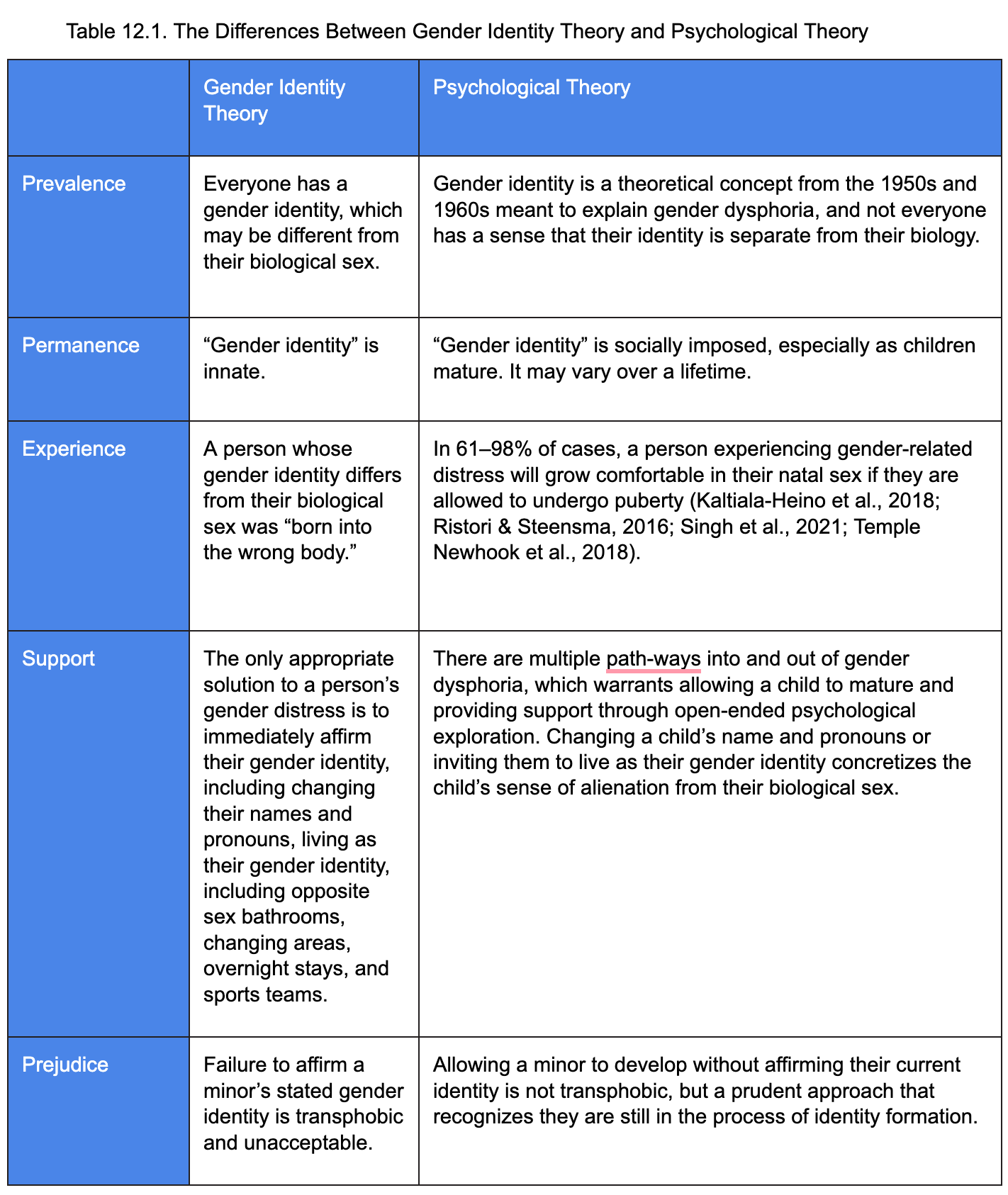
The differences between gender identity theory and the psychological theory are outlined in Table 12.1.
If schools decide to present gender identity theory, it is crucial to explicitly frame it as a disputed and controversial theory rather than an established fact, ensuring that only age-appropriate material is included. Just as it would be inappropriate to teach Shakespeare to very young children because they are not cognitively or emotionally developed enough to handle the complexity of his work, teaching about abstract concepts such as gender identity or gender dysphoria is equally inappropriate. Similarly, it would be unwise for schools to teach young children about the rare possibility of childhood schizophrenia and hearing voices since children are impressionable and might mistakenly believe they have these symptoms.
Given that the ideas of gender identity ideology are contested and may negatively affect some students, it is advisable that such material remains outside the standard school curriculum entirely. Families often have different values, beliefs, or knowledge about their child’s developmental history and personal circumstances that schools do not possess. If schools choose to discuss gender identity theory at all, it must be clearly presented as theoretical and debatable, ensuring transparency and parental involvement. School staff should work with parents to provide comprehensive information about curriculum content and, if necessary, ensure parents have formal access to this information. This transparency enables parents to make informed decisions or objections regarding their child’s education.
12.2.2 Social contagion and schools
As discussed in earlier chapters, the sharp rise in the number of people identifying as transgender and the accompanying demographic changes in the gender-distressed patient cohort may be partially explained by social contagion (Littman, 2018). The work of Dr. Littman, a physician-scientist with expertise in public health who coined the term “rapid onset gender dysphoria” in her 2018 paper, was outlined earlier in this book. In short, Dr. Littman surveyed parents of trans-identified adolescents who described that the onset of their children’s gender dysphoria occurred in the context of belonging to a peer group where one, multiple, or all of a child’s friend group reported gender dysphoria and identified as transgender during the same time frame. In many cases, parents reported an increased use of social media/internet prior to disclosure of a transgender identity. These adolescents did not exhibit gender dysphoria as children, and many were not even gender non-conforming, but the majority struggled due to mental health or neurodevelopmental issues. This led Littman to hypothesize that transgender identification for some youth may be a maladaptive coping mechanism, activated in response to psychosocial stressors that are mediated by sociocultural factors. The idea that gender dysphoria may be socially mediated is an area of active research and debate (Littman, 2018).
Schools may inadvertently act as a vector for social contagion when they adopt affirmation-only school policies, contributing to the instruction-to-transition pathway. Affirming a student’s gender identity or publicly celebrating students who adopt a transgender identity are not neutral actions and can unintentionally influence students’ identity formation (Olson et al., 2022; Wren, 2019; Zucker, 2020). Current research on the affirmation model suggests that affirming a person’s gender identity is associated with gender dysphoria persisting (de Vries & Co-hen-Kettenis, 2012; Olson et al., 2022), and schools must be mindful of this when crafting policy. Since schools have an ethical duty to remain neutral regarding identity outcomes, to collaborate closely with parents, and to prioritize students’ long-term well-being, affirmation-only policies should be explicitly avoided. Schools should instead treat students as individuals, recognizing that there are multiple pathways into and out of gender dysphoria, and support an approach that aligns with evidence-based practices and respects the values of each family.
Tom Neumark is an Education Policy Writer
Dr. Kathleen Goonan is a Physician Executive and Internal Medicine Clinical Practitioner