

How Cass Moved From Equipoise to Advocacy
The slippery rationale for the NHS puberty blocker trial. By Zoe Hollowood

When the Cass Review was published in 2024, those of us concerned about the increasing medicalisation of children with gender distress (GD) welcomed it as a turning point. Although some believed the Review could have gone further, one of its strengths was its intellectual discipline and restraint. Faced with a weak evidence base, it did not draw conclusions beyond what the available evidence could support.
At times, this caution could be frustrating. Not least, the Review describes in detail cognitive development during puberty and the central role of sex hormones on this development. It is reasonable to hypothesise that interrupting this process will affect cognitive maturation. Yet the Review concluded cautiously that puberty suppression may disrupt brain maturation whilst ensuring it documented the one study reporting poorer executive functioning in adolescents. This illustrates the restrained approach it used throughout.
However, Baroness Cass’ recent Parliamentary Briefing in support of the PATHWAYS trial adopts a very different tone, presenting a much stronger and at times unevidenced case for why the trial should proceed (e.g. buying time, harm reduction) whilst minimising potential arguments against the trial (e.g. risks, completion of the data linkage study). See table 1, emphasis added.1
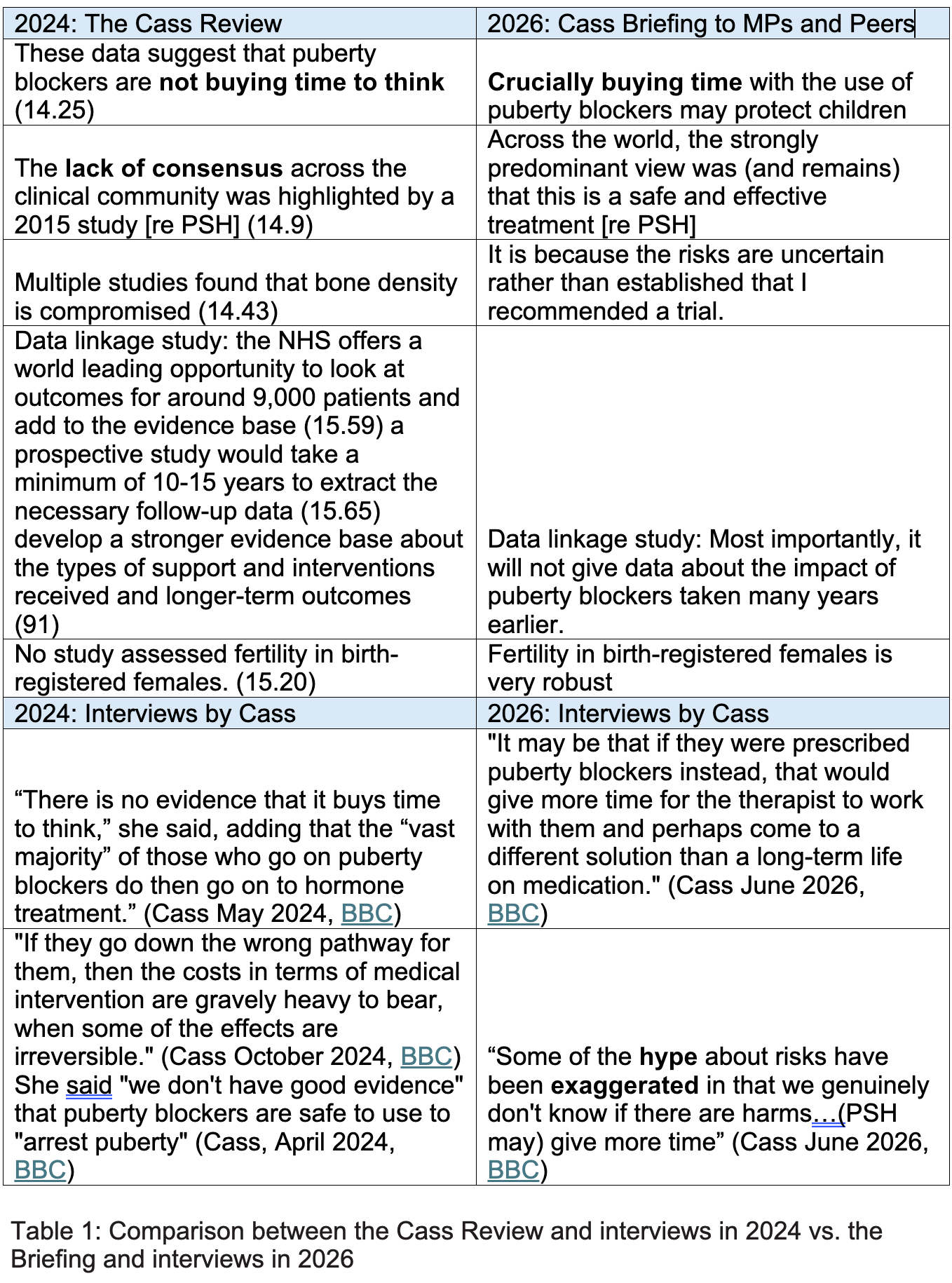
In addition to the inconsistencies above, several distinct themes emerge when comparing the Briefing and Review.
1) From uncertainty to advocacy: As previously discussed, one strength of the Review is its disciplined use of uncertainty regarding the treatment of children with GD. The briefing contains much stronger language such as: “more children will be harmed if we do not do the study than if we do.” That is an extraordinary assertion with no new peer-reviewed evidence to support it.
2) From evidence generation to harm reduction: Cass increasingly argues that the trial must go ahead on the basis that children are self-medicating using unregulated providers and that long waiting lists have left children vulnerable to online misinformation. Yet PATHWAYS is not designed to answer whether offering puberty blockers reduces those harms. The primary endpoint is a self-reported quality-of-life questionnaire (KIDSCREEN-10). There appears to be a mismatch between the rationale being advanced by Cass in the Briefing and the questions the study is actually designed to answer.
3) From addressing the upstream root causes to managing downstream consequences: many of the Review’s recommendations are aimed at changing the environment and bringing gender medicine back towards mainstream evidence-based care rather than its current exceptionalism, e.g.:
reducing misinformation (§100; recommendation 16)
investigating and improving psychosocial care (§ 66 §88 recommendations 3, 6)
regulating overseas prescribing (§156 §158 recommendation 27)
improving data collection (a lot! E.g. recommendations 5, 6, 17, 18, 20, 30)
The Briefing takes a more hopeless tone to the ability to change the environment on the basis of prolonged exposure to misinformation. This apparently makes a puberty blocker trial inevitable on the logic that “children, young people, and families had been told for over 15 years—by both online sources and clinicians—that puberty blockers were safe, effective, and even lifesaving. These beliefs are now deeply embedded” (Cass Briefing). Additionally, the Briefing injects urgency, stating: “These risks are immediate and deeply worrying” regarding unregulated prescribing.
There are positive steps that can be taken to address the public health crisis Cass identifies that are consistent with the Review, including better public health education, reviewing regulatory powers to stop rogue prescribers, completing the data linkage study to understand longer-term effects, and starting a trial on psychosocial interventions. The problems highlighted need a serious systems approach to address them – the trial will not help with this, and this desire to solve an acute public health crisis with ‘a pill for every ill’ approach has the potential to set up future chronic issues.
The very existence of a nationally publicised NHS trial may alter expectations among children and parents regarding the efficacy and legitimacy of puberty blockers. Positive findings on short-term patient-reported outcomes and without long-term safety data could increase the number of children presenting with GD and influence future demand for puberty blockers (e.g. see §8.50 Cass Review). The current trial is not designed to measure this, and unlike the Review, Cass’ briefing does not discuss this risk of increased demand.
None of this diminishes the value of the Cass Review. The Review remains an important piece of work precisely because of its intellectual discipline, scientific rigour and evidence-based restraint. The arguments in the Briefing supporting the PATHWAYS trial depart from those principles. Cass is right that there is a public health crisis in gender medicine after years of misinformation and unregulated providers capitalising on this with vulnerable mis-sold families. The way out of this is not a trial to help justify and perpetuate this practice. It is to go back to first principles. First do no harm.
Zoe Hollowood is a PhD scientist who works for a medical charity and is Chair of Liberal Voice for Women. LVW is a membership group within the Lib Dems campaigning for sex-based rights and child safeguarding.

Genspect publishes a variety of authors with different perspectives. Any opinions expressed in this article are the author’s and do not necessarily reflect Genspect’s official position. For more on Genspect, visit our FAQs.
Thank you, Zoe.
Until I read your article, I hadn’t realised just how different Cass 2026 is from Cass 2024. The evidence in your table is particularly revealing. Thank you for your work and insights.