

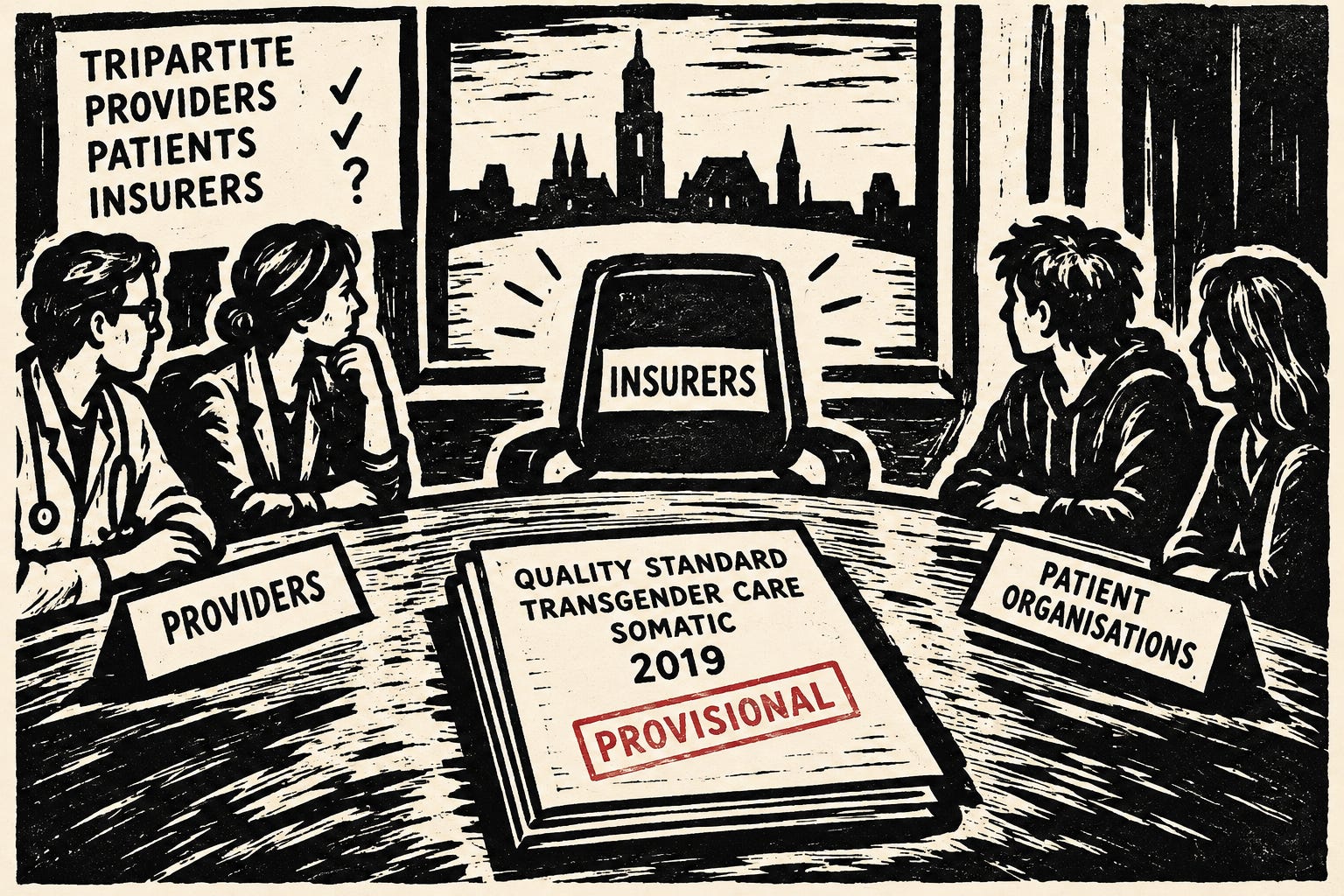
A Freedom of Information release from the Dutch Ministry of Health reveals how the 2019 Kwaliteitsstandaard Transgenderzorg Somatisch (Quality Standard for Somatic Transgender Care) was developed. The documents show a process that sidelined insurers, elevated one activist organisation as the primary patient voice, and treated the standard as provisional from the start — while political pressure pushed toward lower barriers to medicalisation.
Insurers Kept Out to Protect the Compromise
The standard was written by medical professional groups and Transvisie, the main Dutch transgender advocacy organisation. Care insurers were not at the table.
Internal emails from 2020 make the reason explicit. Officials discussed whether to involve insurers later. The concern was clear: insurers might “want [to do] a whole lot of things differently and overturn the entire quality standard.” After providers and patient advocates had finally reached agreement, officials preferred not to reopen the process.
This is a textbook case of path dependence, in which early choices lock in particular outcomes. Once terminology, treatment pathways and indication criteria are fixed, any late-arriving party can only comment on the margins. Insurers were the party most likely to ask hard questions about long-term outcomes, complications, evidence quality, controllability of indications, aftercare, and whether treatments can responsibly be purchased as insured care. By keeping them out at the formative stage, the process structurally delayed such questions.
Later documents confirm the problem. The original standard was never submitted to the Dutch Healthcare Institute (Zorginstituut Nederland) through the required three-party process involving providers, patients, and insurers. When a revised version was later planned, officials explicitly said that a tripartite process would be required before the standard could be registered. In other words, the original process was later recognised as incomplete.
Who Represented the Patient Voice?
The activist organisation Transvisie sat in as the patient representative. That is not unusual in Dutch guideline development: patient groups routinely speak for a constituency rather than for every individual patient. The deeper question is which patients that constituency actually represents, and which experiences it leaves out.
When officials prepared the evaluation of the standard, they and Transvisie (together with Transgender Netwerk Nederland) decided not to hold a new, broad patient consultation. They said this would overlap with an earlier survey by the government’s “Kwartiermaker,” and that another survey would burden transgender people who might also struggle to understand it. Instead, they planned focus groups with “vulnerable groups,” organised in cooperation with the same advocacy organisations
This decision is documented, and it raises a legitimate methodological concern. People who remain satisfied with transition are more likely to remain in contact with advocacy groups that frame medical transition as the solution. People with complications, ongoing pain, sexual dysfunction, mental health deterioration, or regret are less likely to be in that network. Families who dispute the narrative that led to treatment are also unlikely to be represented. The result is a risk of selection bias in the “patient perspective.”
The Ministry itself noted in 2019 that more research was needed on the experiences of vulnerable groups insufficiently covered by existing studies. The literature search conducted for the later evaluation highlighted comorbidity with other mental health conditions, lifelong care needs, and vulnerable populations as prominent themes. Yet the process still routed much of the patient input through organisations focused on expanding access.
Provisional from the Start — and Under Political Pressure
The 2019 standard itself admitted that transgender care is “relatively new care that is strongly developing.” It therefore had “a provisional character from the outset” and recommended that it be assessed annually for currency. An evaluation after two years was meant to launch the maintenance process.
This claim deserves closer scrutiny. Somatic transgender care in the Netherlands dates to the 1960s, with the work of Van Emde Boas and De Vaal. Paediatric gender care was already being provided in the 1980s by clinicians such as Gooren and Cohen-Kettenis. Puberty blockers were introduced in the 1990s and, from around 2000, became the standard approach for minors. By the time the 2019 quality standard was written, the Dutch protocol had already been in clinical use for decades and had heavily shaped international practice. To describe the field in 2019 as still “relatively new” and “strongly developing” understated both how long this care had been practised and how much evidence should already have been available for critical review.
Internal correspondence shows no clear process agreements for this evaluation. Some parties had taken part only reluctantly. Transvisie had pushed hard for the evaluation clause. Officials expected that the Federation of Medical Specialists would not prioritise the work unless the Ministry provided extra funding, because many guidelines in other fields were already outdated and waiting in a large backlog.
Meanwhile, political and activist pressure focused on depathologisation, the idea that being transgender is not a mental illness and should not first require a long psychological assessment. The Dutch advocacy group Transvisie backed that shift, as did a 2021 motion in parliament from D66, a progressive-liberal party, which asked the government to have doctors’ associations consider dropping extensive psychological evaluation as a gate to hormones or surgery and instead use a quick triage check so that people without serious distress or extra mental-health problems could move faster to the physical treatments they wanted, based on the WHO’s ICD-11 diagnosis of gender incongruence. The Health Ministry’s official advice was to stay “role-fixed”: politicians should not decide what counts as good care; that is for the professional field; yet the Ministry funded the review and managed the political traffic around it.
High-priority modules flagged for revision included indication criteria and treatment of children. The best-implemented module was hormone treatment; the least was organisation of care.
What This Means
The documents do not prove that people with regret or injury were deliberately excluded from the original working group. That claim would require direct evidence of selection and exclusion that is not present. What they do show is a process with structural weaknesses:
One of the three parties (insurers) normally required for a robust quality standard was excluded at the formative stage to avoid disruption.
Patient input was channelled primarily through advocacy organisations oriented toward affirming medical transition, while a broader independent consultation was declined on grounds of burden.
The standard was acknowledged as provisional from the beginning, even though the underlying clinical approach had already been practised in the Netherlands for decades, and political energy was focused on lowering rather than tightening barriers.
For anyone later harmed by this care, this history is relevant. When a clinic or hospital says “we followed the quality standard,” it is fair to ask how much authority that standard can claim if it was written without insurers, on a narrow patient base, and under a process that later had to be corrected.
Dutch authorities have since moved toward a more formal tripartite evaluation and revision process involving providers, patients, and insurers. That is an implicit admission that the original construction was incomplete. The FOI documents show how that incompleteness arose, and whose voices were structurally privileged along the way.
The lesson is not unique to the Netherlands. When guidelines on irreversible medical treatment are written under activist pressure, without the full range of stakeholders, and presented as provisional even after decades of clinical practice, they should not be treated as settled science. They should be treated as what they were: a provisional, path-dependent compromise that still needs rigorous, multi-party, evidence-based scrutiny.
Genspect publishes a variety of authors with different perspectives. Any opinions expressed in this article are the author’s and do not necessarily reflect Genspect’s official position. For more on Genspect, visit our FAQs.