

NZ poll shows majority opposition to transgender beliefs
A solid majority of voters oppose hormone interventions for minors with gender distress.

A recent Curia poll question, commissioned by Genspect NZ, found the majority of respondents don’t support children being allowed to make life-altering medical choices before they can understand what they are signing up for.
The poll conducted between 4-8 June, asked a random sample of 1000 adults questions pertaining to sex and gender. One of these was:
Do you agree that hormone interventions to treat distress about one’s sex should not be available to those under 18?
The results were clear and unambiguous. The answer was YES: children should not be able to access medications that have effects they have no capacity to understand.

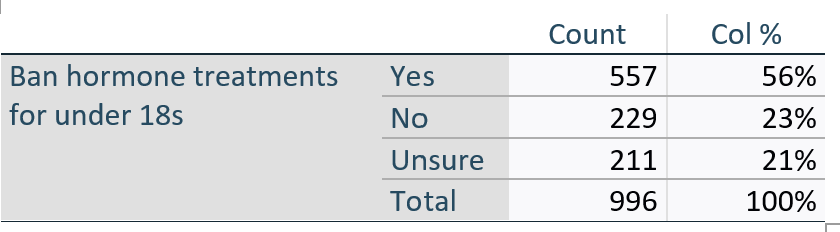
56% of respondents agreed that under 18s should not be treated with puberty blockers and/or cross sex hormones, while 23% disagree.
Younger adults were the most likely to agree, by a margin of roughly 3:1.
61% said under 18s should not be treated, compared with only 19% who disagree.
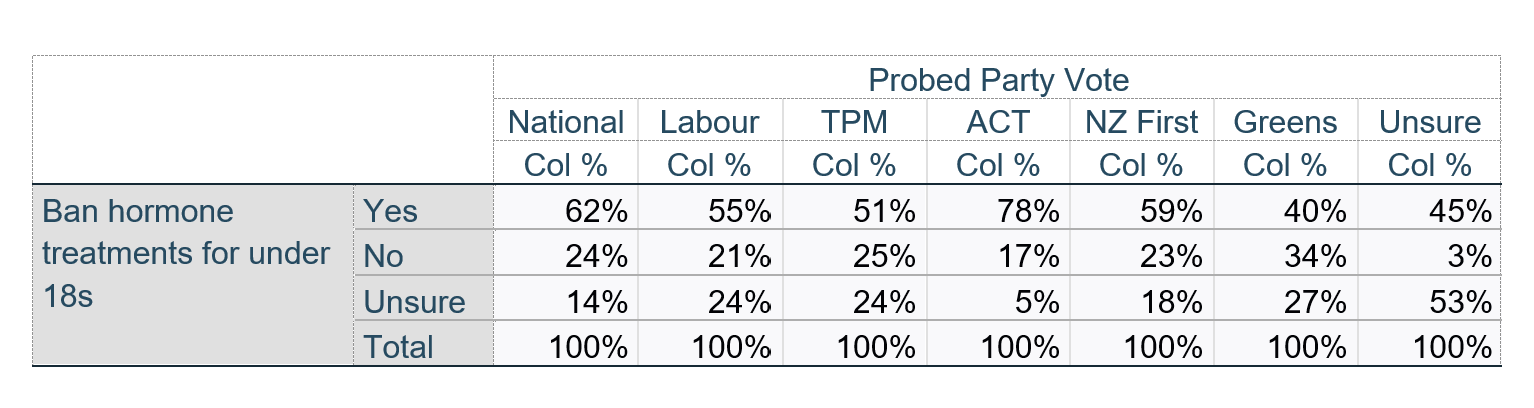
Across supporters of every political party, more people agreed that the treatments should not be available than disagreed. If reflected in policy or law, this would align New Zealand with the UK, where puberty blockers are banned for under 18s.
The Cass Report (UK), the US Department of Health and Human Services (DHHS) review of evidence and best practices and similar reviews in Sweden, Finland, Norway, Denmark, Italy, and Russia have halted the prescribing and administration of puberty blockers to children. Reviews found that existing studies supporting this practice were of poor quality, lacked evidence on the long-term impact of taking hormones from an early age and downplayed or did not address the risks involved in “gender affirming care”.
In New Zealand the guidelines previously written by the Professional Association for Transgender Health Aotearoa (PATHA) received a very poor grade for quality in the independent Cass Review. PATHA’s guidelines received only 140 out of a possible score of 600, with a zero score for editorial independence and 12 out of 100 for rigour of development.
As the reality of the harmful effects of blocking puberty has become more obvious and well-known, public support for this practice is declining, according to this poll. The almost 100% continuation from puberty blockers to cross sex hormones is not a trivial outcome. Neither is the limited evidence, likely infertility, sexual dysfunction, weak bones and impacts on mental development.
This might account in part for the 61% of 18–39-year-olds who do not support the medicalisation of children’s bodies. This is the population cohort who may be most likely to know someone who has received “gender affirming care” and have firsthand knowledge of the deleterious reality of this practice.
New Zealand children are indeed being prescribed hormone ‘treatments’, sometimes without parental knowledge.
One GP supporter of Genspect says, “I think the public needs to know that gender clinics all over the country are prescribing hormones to under 18s. Many from age 15. We don’t know how many this is happening to, but whether it’s a few or whether it’s many, the concern is that is is happening in NZ without proper evidence or scrutiny.”
Health NZ is not tracking these hormone treatments because it doesn’t request information on the clinical indication for the prescription. And it does not know whether the ‘sex’ recorded for the patient is the person’s natal sex or their ‘gender identity’.
Not a left/right issue
Of interest in the poll results was that voters for every political party were more likely to oppose hormones for under 18s than support them. Green Party voters were also more opposed than supportive and had the highest number of respondents who were “unsure” among those who stated a political party voting preference.
Would the poll cohort who are “unsure” about the use of life-altering hormone treatment for children come to a more resolute conclusion if they knew more about exactly what puberty blockers do to the bodies and minds of children? The same children who are considered too young to get a tattoo because these are considered to be permanent bodily alteration.
Protecting women-only public spaces is not a “fringe issue”
Another question that this Curia poll asked (on behalf of the Women’s Rights Party) was:
Should men who identify as women (often called “transwomen”) be allowed to have open entry into all designated single-sex spaces for women and girls?
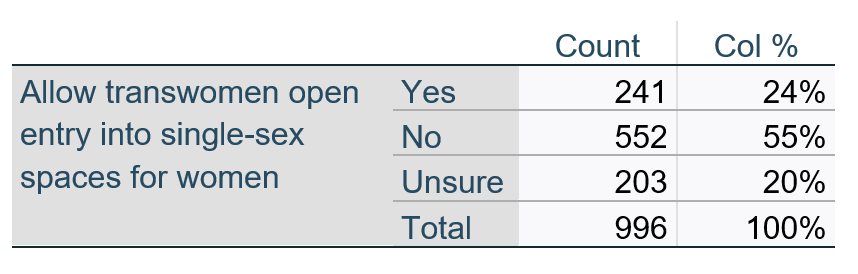
Only 24% of respondents supported men having open access to use women’s restrooms, prison cells, sports categories, and every other space that was set up to keep women safe enough to allow full participation in the public sphere.
55% were opposed to men who claim a female identity having open entry to the protected single sex spaces that women require; only 24% support men intruding on women’s spaces and the remaining 20% weren’t sure.
This represents quite a shift from only three years ago (2023), when the same question was asked and 47% were opposed to males in female spaces.
The 24% of respondents included in the latest poll who supported men who identify as women being allowed in women’s and girls’ single-sex spaces is significantly fewer than the level of support in 2023, which was 34%.
Demographic differences
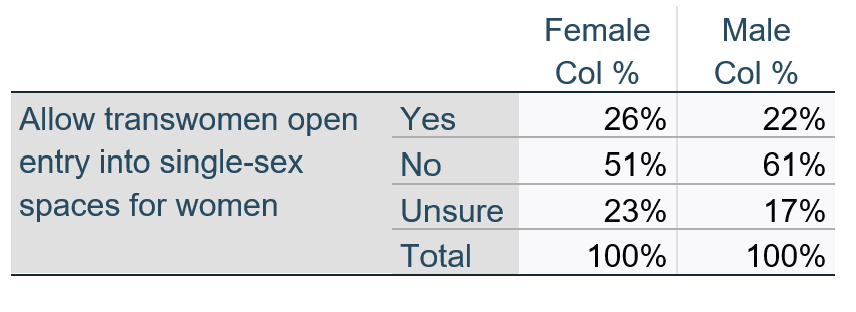
There has been a big increase in men who are opposed to males who identify as women being allowed in female spaces. In 2023, 44% of men said “No” to the question; in 2026 that proportion has increased to 61%.
In 2023 more women than men opposed males in women’s single-sex spaces. Now it is the other way round with 61% of men saying “No” to the question compared with 51% of women. More women than men are supportive of open access for males (26% compared with 22%); still, a majority of women (51%) are opposed.
Younger respondents’ opposition to men being allowed in women’s spaces has grown in the last three years with 48% of 18- to 39-year-olds saying “No” compared with 36% in 2023. Only 30% of younger respondents now support the question (down from 44% in 2023).
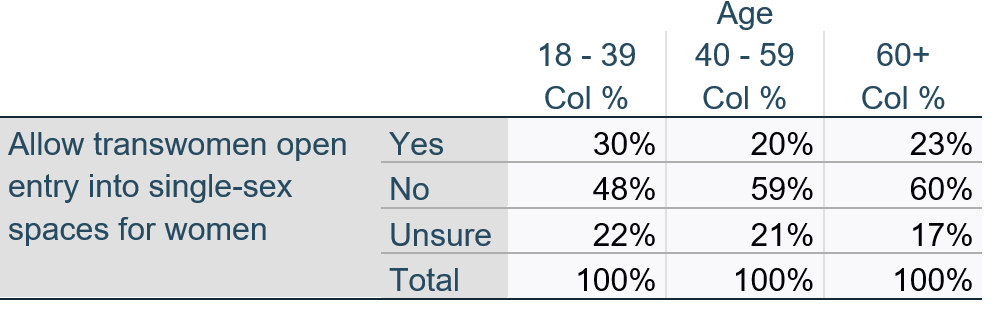
Older respondents have hardened their opposition with a large majority saying “No” (59% and 60% respectively, up from 48% and 54% respectively in 2023).
As people begin to understand more fully the issues involved, the importance of single sex spaces for women and girls, and the fact that humans cannot change their sex, more people are now pushing back against the “no debate” stance that has dominated transactivist and media narratives in New Zealand.
Political parties: time to pay attention
A third question in this Curia poll was asked on behalf of Speak Up for Women (SUFW):
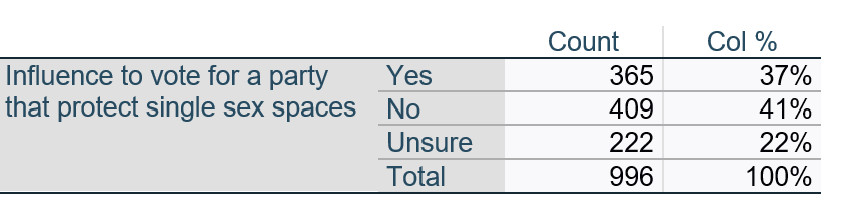
If a political party has policies that protect single-sex spaces, services, and sports, will that influence you to vote for that party?
The main results were:
In a media release, SUFW spokesperson, Suzanne Levy, said,
“That figure should get the attention of every political party. Not every voter considers these issues decisive, but more than one in three say they would be influenced by a party’s willingness to protect women’s spaces and female sporting categories. Political parties spend enormous time and resources chasing small groups of swing voters. A policy position that influences more than a third of the electorate is not something that can simply be dismissed.”
Taken together, these three polls show a move away from the ‘no debate’ acceptance of transgender beliefs. There is now a solid majority in most cohorts of voters who oppose the basic tenets of transgender ideology - that men can become women and that children can “know” they were “born in the wrong body” so “need” radical hormonal interventions.
In response to these polls, Jan Rivers, the spokesperson for Genspect NZ, said,
“It appears we have passed the high water mark for the acceptability of these damaging interventions that carry significant consequences for children and young people.”

Genspect NZ is delighted to announce that Dr. Stella O’Malley, psychotherapist and founding Director of Genspect will be the keynote speaker (in person) at our 2026 Conference to be held in Wellington in October. For more information about Dr O’Malley see https://www.stellaomalley.com/
Please donate to support Stella’s visit by making a donation to our bank account Genspect NZ Limited 02-1257-0087070-000.