

An Interview with "Karlee"
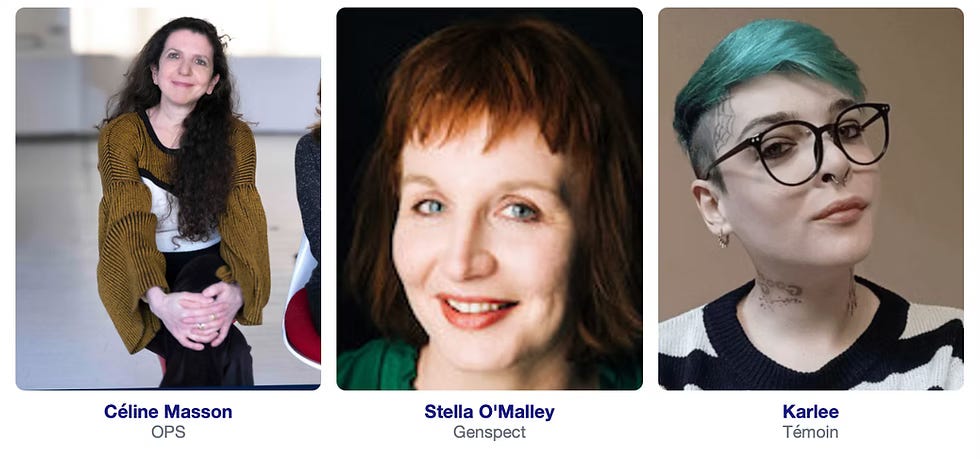
Céline Masson and Stella O’Malley interview "Karlee Monster"
Read the interview in French here
Accounts of transition regret today constitute a valuable resource for understanding the complexity of gender-transition pathways. Long left largely unheard, these voices allow us to examine the expectations of those who begin a transition, the benefits it can bring, but also its limits and the reasons that lead someone to reconsider that choice.
With this in mind, Stella O’Malley, psychotherapist and director of Genspect, and Céline Masson, professor of clinical psychology and co-director of the Observatoire La Petite Sirène (OPS), conducted an interview with a person born male who came to regret their transition. One cannot speak of detransition since, having undergone surgery (vaginoplasty), Karlee can no longer recover the body he had.
Without seeking to overgeneralize from an individual experience, this conversation brings to light the psychological and social dimensions that can mark such a journey, and opens a space for clinical reflection beyond ideological divides.
[Stella O’Malley and Céline Masson]
When you first began to think that transition might be a solution, what were you going through at that time in your life? Looking back, do you feel this step was solely a response to a discomfort connected to your body or your sex, or was it also an attempt to cope with deeper difficulties? If so, which ones?
[Karlee Monster] My name is Karlee — or at least it’s the pseudonym I’ve chosen in order to speak out. I’m 31, and I live in the North of France. At 17, I began a gender transition without my parents’ consent. This early transition would later lead to regret, which is why I decided to speak out, first in the media and then in a recently published book: Certaines blessures ne se referment pas [Some Wounds Never Heal], written with the help of a ghostwriter and self-published on Amazon.
I started thinking about transition at 17. Before that, I had never really felt any unease or any “mistake” about my gender. What I couldn’t bear, however, was my homosexuality and my femininity. Because of it, I was bullied at school and, above all, beaten at home. At seventeen, I was in a relationship with another boy, and I wasn’t at peace with my homosexuality. “Becoming a woman” seemed to me a way to no longer carry the shame of my orientation. At the time, I had started a vocational course (CAP) in catering, and I felt a constant discomfort because of my femininity. I think that, by transitioning, I was trying to flee homosexuality, the homophobia I was subjected to, the shame of being myself — to flee who I was, to flee my life. It was the moment I discovered, on the internet, that one could change gender that everything shifted: shame about body hair, shame about what was, ultimately, too masculine.
[SO/CM] France differs from English-speaking countries in its cultural, social and medical context. Looking back, do you feel these specificities influenced your journey? Or do you recognise, in your own experience, dynamics comparable to those described by people who have detransitioned in other countries? Which ones seem common to you, and which seem specific to the French context?
[KM] I have the impression that my journey is fairly similar to the testimonies I’ve seen in other countries. I think I was influenced by the people making YouTube videos, who claimed that it had fixed everything in their lives — and that it was available to anyone who wanted to “feel better.” Doctors quickly steered me towards transition, using shortcut questions like “As a child, did you like pink and Barbies?” The other accounts broadly resemble mine.
[SO/CM] Many people who have detransitioned say that transition first brought them real relief, without truly resolving their suffering. At some point in your journey, did you become aware that transition was not addressing the deeper psychological difficulties you were going through? What led you to see your experience differently?
[KM]I felt relief for several years. It was like a miracle. Then, few years later, shortly before my vaginoplasty, I began to realise that it couldn’t solve every problem — that it wasn’t going to repair my past, my traumas. But despite my doubts, I wanted to go all the way to genital surgery, because I thought that was what would finally let me become, truly, a woman — and so, perhaps, settle my problems for good. I was in a kind of dawning awareness mixed with enormous denial. It was only when I woke up from the final operation that I realised not only that I was no more a woman than before, but also that it had not repaired me.
[SO/CM] If you could speak today to the health professionals who accompanied you through your transition, what would you want them to understand about your journey? Is there a question you wish they had asked you, but that was never put to you?
[KM]I would have wanted my mandatory psychological follow-up to actually be carried out properly. And I would like that mandatory follow-up to be put back on the agenda — and for it not to end once the hormones are prescribed. Psychological or psychiatric follow-up must be provided by doctors trained in gender dysphoria, transition and detransition. The specialist cannot be assigned at random: they must ensure that the wish to transition does not stem from abuse, and that it is not being influenced. At the time, I would also have liked everything to be explained to me in detail before I took the first pill — in particular, what a vaginoplasty really is: what it looks like, how it has to be maintained, the side effects, how it feels. I would have wanted the surgeons not to list only the “upsides,” not to smooth over their message. Nor was I informed of the side effects of the hormones. And finally, I would have wanted to hear the testimony of people who regret — not only positive accounts — so that I might realise that yes, some people do regret.
[SO/CM] You lived this experience from the inside, and today you see your journey differently. What message would you like to pass on to parents, therapists, and young people going through comparable suffering? Beyond political or ideological debates, what has this experience taught you about psychological suffering, about the development of identity, and, more broadly, about the human condition?
[KM] To parents: whether you want it or not, your child may transition if they wish to. It is better to support them, to give them every tool to form a realistic picture. Find them good specialists who are neither influenced nor easily influenced. Encourage them to seek several different opinions. Encourage them to take their time — to wait until they are twenty-five. Explain to them that even if they are sure of themselves now, he or she can always change their mind later. There is no wasting time on matters as important as this.
To therapists: they absolutely must stop being so radical — either 100% pro-transition and activist, or outright transphobic. Doctors must be neutral and help their patients; there is no place for ideology in medicine! Doctors who check a patient’s stability before letting them transition are not transphobic — they are simply being careful.
To young people who wish to transition: take your time. I too was in a hurry, and I ultimately made the mistake of rushing. I would have liked to meet myself calmly at thirty, and not be where I am today. I know you’re impatient, but don’t believe it: it won’t fix everything. Don’t take the risk of regret. Do serious psychoanalytic work before embarking on transition. Going back, even where it is possible, is not without consequences and lasting harm. Life will be hard if you regret it — perhaps even worse than at the start. You will then have to try to think about something else, which will not be easy. Finally, I recommend reading my book, which will help you realise that I have been through this — and that I can therefore only understand you.
Thank you for this interview.
Céline Masson and Stella O’Malley
You can read Karlee Monster’s testimony - Some Wounds Never Heal - Available exclusively on Amazon / Follow Karlee on Instagram “Karlee.Monster”
Genspect publishes a variety of authors with different perspectives. Any opinions expressed in this article are the author’s and do not necessarily reflect Genspect’s official position. For more on Genspect, visit our FAQs.