

We are only beginning to understand the long-term effects of the testosterone administered as part of gender medicalization, especially after puberty blockers, but one thing we do know is that high doses of testosterone suppress the capacity of the ovaries to produce estrogen. The natural decline of estrogen production in menopause has a known impact on women’s health. While there are important differences (sometimes changes are partially reversible), looking at the effects of menopause gives us an idea of what the real-world impact of testosterone on trans-identified females might be.
Testosterone in Women’s Bodies
Testosterone occurs naturally in the female body. Small amounts are released into the bloodstream from the ovaries and adrenal glands. Testosterone plays an important role in creating and maintaining bone mass, generating new blood cells, maintaining libido, and regulating mood. The combined effects of testosterone and estrogen assist with the growth, repair, and maintenance of female reproductive tissues.
Women naturally produce far less testosterone than men, about 15-fold less, especially after puberty. Trans-identified females are prescribed much higher amounts of the male androgen to achieve a desired ‘manly’ look. While the resulting deeper voice and hair growth are the desired effect—the whole point—these changes are permanent. So are others like male-pattern baldness and clitoral enlargement, which may cause discomfort and distress.
Too much testosterone does not make a woman into a man, but it does create health problems associated with a lack of estrogen in menopause.
It is not just too much testosterone, but the absence of estrogen production (which has been suppressed by exogenous testosterone) that leads to health concerns. For example, in the population of women who have their ovaries removed for medical reasons (cancer, endometriosis, ovarian cysts, etc.), the resulting loss of estrogen pushes them into a “surgical menopause.” They are typically treated with Hormone Replacement Therapy (HRT) and carefully monitored for bone loss, cardiovascular health, and treatment side effects. Even relatively moderate amounts of testosterone given to trans-identified females can suppress estrogen production enough to induce a chemical menopause. Some may also elect to have their ovaries and uterus surgically removed, most often as a supposed “gender-affirming” measure (to eliminate menses or to facilitate phalloplasty), after which they lose virtually all capacity to produce estrogen on their own.
Similarities and Differences with Natural Menopause
Many of the health problems experienced by trans-identified women in their teens and 20s who have taken testosterone closely resemble those faced by women from around age 50 onward in natural menopause. Let’s look at some of the most important.
Osteoporosis
Menopause increases the risk of osteoporosis, a condition that makes bones brittle and more likely to break. This happens because estrogen levels decrease during menopause, which slows bone formation and repair.
Girls given puberty blockers are at risk of reduced bone mineral density (including osteopenia and, in some cases, osteoporosis) because the sex hormones normally released during puberty are essential for accelerating and consolidating bone growth and peak bone mass. Absolute bone density often remains stable while on blockers, but Z-scores (which compare a person’s bone density to the average for their age and sex) decline relative to their peers who continue to accrue bone. Testosterone use may mediate these effects, though the degree of recovery depends on factors such as the duration of blocker use and the timing of hormone initiation.
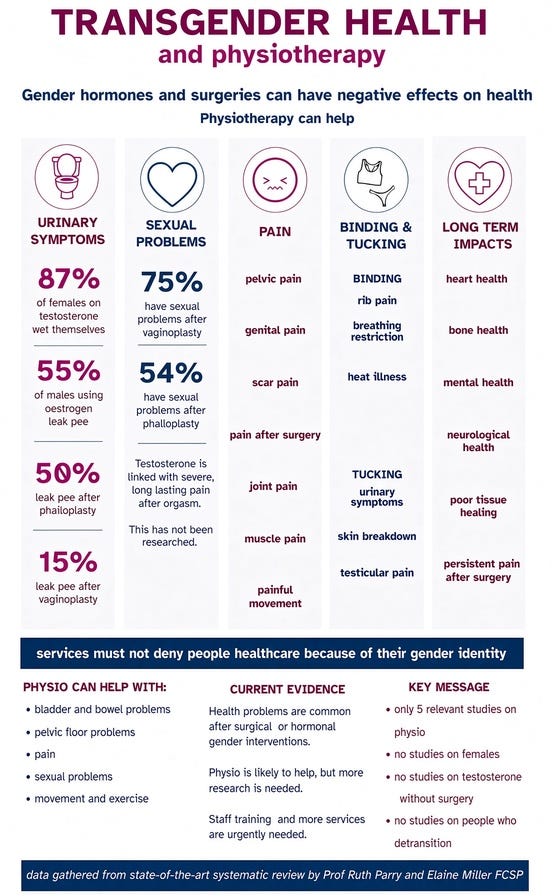
Pelvic Floor Dysfunction (PFD)
The impact of menopause on the pelvic floor is well documented. Tissues atrophy and thin; connective tissue and muscle tone weaken. These menopause-related changes in the pelvic floor may lead to urinary incontinence, overactive bladder symptoms, pelvic organ prolapse, recurrent urinary tract infections, vaginal dryness, sexual dysfunction, and in some cases chronic pelvic or musculoskeletal pain. Reduced estrogen in trans-identified females can lead to these symptoms and others associated with testosterone use.[i]
Incontinence and Related Symptoms
Urinary incontinence is virtually guaranteed for trans-identified females taking testosterone doses (and for an unlucky few, fecal incontinence). One study found “Transgender men on hormone therapy have a high incidence of PFD (94.1%) and experience a greater occurrence of urinary symptoms (86.7%).”
The impact of incontinence is much greater than the embarrassment and practical problems of managing leaks. It can lead to a painful, distressing form of dermatitis. The delicate skin of the labia and vulva is not designed to be constantly bathed in urine, which is very acidic. Thus, the standard care for older, bedridden women who are wearing incontinence underwear is daily perineal care to preserve skin integrity in this sensitive area.
Urinary Tract Infections
Another symptom associated with PFD is an increased risk of urinary tract infections (UTIs). The reduction of estrogen production in menopause causes genital tissues to thin, which may cause the bladder to change position and develop thinner, less elastic walls. This, in turn, widens the urethra, making it easier for pathogens to enter and making frequent UTIs more likely. Many older women suffer from chronic UTIs, leading their bladders to become colonized by bacteria, causing chronic infections that can be nearly impossible to totally eradicate. Because of this, it is becoming standard practice to offer older women intravaginal estrogen cream, which helps maintain pelvic health. However, trans-identified females may be reluctant to use estrogen therapy.
Loss of Tissue Elasticity
Loss of elasticity in the pelvic floor due to reduced estrogen after menopause also affects the surrounding tissues. For instance, there is a complex but well-documented relationship between the health of the pelvic floor and lower back pain. Another associated symptom is lower-limb edema, which may lead to chronic cellulitis, infections, and other severe skin problems. Trans-identifying women experience many of the same symptoms
Genital Changes
One issue trans-identified women experience uniquely is clitoromegaly (enlarged clitoris), an expected side effect of exogenous testosterone use in women. In some instances, the clitoris protrudes enough that wearing normal clothing becomes painful. Some women find this enhances sex, but others find it difficult to achieve orgasm or find it so painful post orgasm that they avoid sex altogether. Additionally, the reduced elasticity of the pelvic floor may make orgasm difficult to achieve because of reduced muscle tone.
Dementia Risk
It has long been established that premature menopause (occurring before age 40) increases a woman’s risk of developing dementia later in life. Estrogen deficiency reduces the hormone’s neuroprotective effects on synaptic plasticity and impairs mitochondrial function and survival in brain cells.
Women generally show a lower mid-life dementia risk but a higher late-life Alzheimer’s disease risk compared with men. Emerging data indicate that trans-identified females taking testosterone have higher late-life Alzheimer’s risk scores than both men and women who are not using cross-sex hormones. This elevation appears to be driven primarily by higher rates of modifiable risk factors such as depression, chronic stress, cardiovascular disease, and social isolation. The relative contribution of hormone therapy itself remains difficult to separate from the broader mental-health comorbidities and social challenges that frequently accompany trans identification.
Fertility
Discussing “menopause” in the context of young females taking testosterone is complicated. The formal definition of natural menopause includes permanent cessation of menses due to ovarian follicle depletion and the resulting loss of natural fertility. (Rare experimental cases of pregnancy in older post-menopausal women have required extensive medical intervention and carry high risks.)
However, an important distinction exists regarding fertility. In trans-identified females, the amenorrhea (when menstruation stops for 3 months or more) and other menopause-like symptoms induced by testosterone can often be reversed if testosterone is stopped and pregnancy is desired. Nor does ovulation necessarily cease simply because menstruation has stopped; studies show that a substantial minority of amenorrheic females on testosterone continue to show histological evidence of recent ovulation. Therefore, trans-identified females who have sex with males cannot assume they are infertile merely because they no longer menstruate while on testosterone.
Other Effects
In addition to the expected androgenic effects—increased body and facial hair, voice deepening, and greater muscle mass—exogenous testosterone typically produces a marked increase in libido. Some trans-identified females interpret these changes not as a form of menopause (a specifically female physiological event) but as a kind of male “puberty” that is transforming their body in line with their desired sex. In reality, they remain the effects of high-dose androgens acting on a female body; they do not constitute male puberty, nor do they transform a woman into a man.
“Men” Having Babies
Trans-identified women can and do become pregnant, but their diminished capacity to produce estrogen greatly complicates pregnancy.
Vaginal Atrophy
Vaginal atrophy due to the dramatic loss of estrogen is one of the most common complaints of menopause. This is also a condition that affects trans-identified females. Some trans-identified females choose to become pregnant, and as already noted, others have accidental pregnancies from using testosterone as a form of contraception. Vaginal atrophy can make penetrative sex very painful, and this makes it difficult to become pregnant without the use of technology.
Carrying a pregnancy to term is even more difficult than becoming pregnant in the first place. An atrophied uterus does not easily stretch and grow to accommodate pregnancy, which can lead to premature births, intrauterine growth restriction, and congenital conditions such as talipes (clubfoot). Studies of pregnant peri-menopausal women, who naturally produce less estrogen, show that they develop smaller placentas, which negatively impacts overall fetal growth and development. The same, or worse, is likely to hold for trans-identified females on testosterone.
The vaginal walls of reproductive-aged women are thick, strong, and elastic enough to accommodate a growing baby. Just as in menopause, the lack of estrogen in trans-identified females causes the vaginal walls to become thin, friable, and easily torn or damaged. As the cohort of young women on testosterone enters their peak childbearing years, we can expect more pregnancies, whether planned or accidental, and this increases the likelihood of birth injuries and planned C-sections, with all the risks and expense that entails.
A Mommy Brain?
New research on brain changes during pregnancy strengthens the observation that female and male bodies differ in fundamental ways shaped by sex-specific biology. Pregnancy produces substantial neuroplastic changes—particularly reductions in gray-matter volume in regions involved in social cognition—that appear to prepare the maternal brain for caregiving and infant bonding. Testosterone administration has been shown in controlled studies to reduce cognitive empathy in women (for example, impairing performance on tasks such as the Reading the Mind in the Eyes Test). This raises a question: how does a female brain that has been influenced by testosterone engage in the necessary tasks of pregnancy so that mothers are prepared to provide the selfless care their babies need to thrive?
Mothers who previously received testosterone and who cannot breastfeed because they have undergone chest masculinization surgery face additional practical and physiological disadvantages. Breastfeeding normally reinforces key hormonal pathways (involving oxytocin, prolactin, and related systems) that support maternal-infant bonding, responsiveness, and resilience. These women love their babies deeply, and like other mothers who are unable to breastfeed, they can still form deep, secure attachments, but they will miss out on much of the hormonal reinforcement that typically goes hand-in-hand with the upheavals of new motherhood.
Women need Estrogen
Women who transition are sold the lie that they can opt into manhood through puberty blockers and/or cross-sex hormones and surgeries. But estrogen and testosterone are not interchangeable. Women’s bodies need estrogen to be healthy, and trying to substitute one for the other is doing no more than entering into a medical compact from which they cannot emerge unscathed as women, and not as any sort of men at all.
Robin Jones is a retired midwife and IBCLC who lives in New Zealand. She has a Master’s degree in bioethics and worked as a volunteer mother-to-mother breastfeeding supporter for over 40 years. She knows that no mammal on the planet can choose or change their sex.
[i] Here is a link to the Clinical Advisory Network on Sex and Gender conference, where Elaine Miller, a Scottish physiotherapist and leading researcher on pelvic problems in trans-identified females on testosterone, spoke. You can find a report on her session here.
Genspect publishes a variety of authors with different perspectives. Any opinions expressed in this article are the author’s and do not necessarily reflect Genspect’s official position. For more on Genspect, visit our FAQs.
Thanks for detailing how awful gender affirming care is. Wish this (and the side effects for transitioning men) were shouted from the rooftops, along with ‘there is zero evidence that you will commit suicide if you don’t transition.’
I truly appreciate the spirit and specificity with which you wrote this piece.