

Queer "Experts", "Trans Kids" and the End of Safeguarding
How the pro-paedophilia lobby used the goodwill toward gay men and lesbians to gain access to children by Jo Bartosch


Ashley Boyd was trusted with children. A male nurse, he served as trans liaison officer at Great Western Hospital and chaired Swindon and Wiltshire Pride until 2023. Last week, the Nursing and Midwifery Council found that Boyd had carried out unnecessary testicular examinations on multiple child patients for his own sexual gratification, despite repeated warnings from colleagues. He has since lost his job. At the time of writing, he has not been convicted of a criminal offence.
Boyd was not a marginal figure operating in the shadows. He was embedded in a network that presents itself as necessary for children’s wellbeing. Swindon and Wiltshire Pride has since sought to distance itself, insisting that Boyd’s role did not involve direct contact with children. This is a curious defence for an organisation that markets its annual Pride event as family-friendly, goes into schools to teach about LGBTQIA+ identities, and welcomes all ages to its community hub.
Cases like Boyd’s are routinely dismissed as aberrations. They are not. They are the foreseeable result of a safeguarding culture that has been inverted. Today, caution itself is treated as a potential hate crime, and safeguarding whistleblowers risk being recast as threats. This is what happened to the Reverend Randall, who questioned the teaching materials of Mermaids and was referred to the counter-terrorism programme Prevent.
In the name of not offending grown men who claim to have always known they were trans, the medicalised fiction of the “trans child” needed to be invented. To forestall interrogation, exaggerated claims about suicide and bullying are routinely deployed to silence and shame critics. To combat this confected crisis, a growing cadre of queer “experts”, often with little relevant clinical or safeguarding experience, is presented as indispensable. Swindon and Wiltshire Pride claims, as do many similar organisations, that using children’s preferred pronouns and names “significantly improves mental health outcomes” and “reduces the risk of suicide by 50%”. This is, to put it politely, manipulative bullshit.
Not so long ago, adults who sought unusual access to children were met with a suspicious side eye. Any group proposing to enter schools to discuss sex with pupils would have faced rigorous scrutiny. The idea that twerking drag queens might dispense moral or educational wisdom to children would not merely have seemed eccentric, but disqualifying. This was not prudishness, but hard-won caution. Successive scandals had taught us that those who abuse children exploit whatever routes are available to them, whether by claiming to “liberate child sexuality”, as with the Paedophile Information Exchange (PIE), or by cloaking themselves in good works.
A veritable parade of Pride organisers and queer educators has now appeared in courtrooms and headlines. The most notorious case remains Stephen Ireland, former chair of Pride in Surrey, a dangerous predator who was quickly championed as a pillar of the community and praised by the police.
What links these cases is not chance, but deference. Many professionals now fear the ‘phobia’ label more than they fear opening the door to potential abusers or dangerous ideologies. Swindon and Wiltshire Pride’s record illustrates how judgment and adult responsibility are waived away by enthusiasm for all things Pride and sparkly.
Last year, The Telegraph reported that the group distributed materials in primary schools explaining an array of sexual and gender identities, resources also promoted by the local council. Each identity was represented by a flag, apparently sourced from My Umbrella, a project affiliated with Reading Pride that explicitly aims to “raise awareness across sexuality, gender, romantic and fetish spectrums.” Although its website is currently undergoing maintenance, My Umbrella previously catalogued 312 flags representing so-called identities and kinks, including “age play” and “slave play.” The site is linked to numerous LGBTQAI+ organisations in receipt of public funding, among them Swindon and Wiltshire Pride. At a time when classic works of literature are routinely removed from classrooms lest they distress children, the unremarked exposure of pupils to concepts lifted straight from niche pornography is treated as entirely uncontroversial.
This is how safeguarding breaks down. And it matters, because what is most shocking about child sexual abuse is not that it occurs, but how routine it is. Child protection, therefore, rests on a deliberately uncomfortable principle: no one is above suspicion.
That principle was forged amid painful historical lessons. As society edged towards accepting gay men and lesbians, and as the grip of the church on public life loosened, the pro-paedophilia lobby sought to attach itself to that struggle. Groups such as PIE in Britain and the North American Man-Boy Love Association in the United States framed child sexual abuse as the next frontier of liberation, borrowing the language of civil rights and leeching off the work of gay rights activists. Both homosexuality and the inclination to abuse children can be described as marginal sexual orientations, but this ought to be where the comparison ends. Many gay men and lesbians fought fiercely to expel these groups, recognising that their presence was morally abhorrent and politically catastrophic.
This was the backdrop to Section 28, an undeniably homophobic and misdirected law that barred local authorities from promoting homosexuality or teaching its acceptability as a family relationship in schools. Its rhetoric was crude and unjust. Yet it did not arise from pure invention. It was responding badly and indiscriminately to a real attempt to blur the boundary between adult sexuality and childhood.
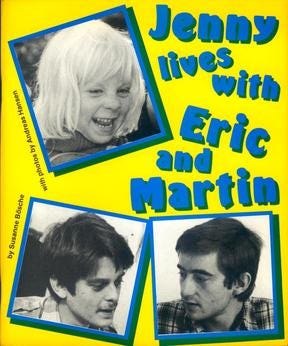
The controversy surrounding Jenny Lives with Eric and Martin captured this tension. The children’s book, intended to promote tolerance, included photographs of two adult men topless with a young girl, including one in which she sits between them in bed. Any discomfort was, and indeed still is, dismissed as reactionary. In hindsight, some of that unease was not irrational, but an intuition that boundaries were being tested under the banner of progress.
Some of those pushing hardest were paedophiles. Others were naive liberals convinced they were advancing children’s rights. While the most overtly dangerous elements were eventually marginalised, the underlying idea that child sexuality exists, and that it should be liberated or curated by adults, never disappeared.
It has resurfaced today in a new guise, and shame over the homophobia of legislation like Section 28 has made it harder to challenge. Many of the arguments now used to legitimise the medicalisation of gender non-conforming youth closely parallel those once advanced by PIE and NAMBLA. Youth transition charity Mermaids insists that children’s capacity to consent to potentially permanent medical interventions should be guided by ‘stage not age’. It is also worth asking what sort of adult would seek to halt children’s bodies from maturing and why. Details from the trial of Pride in Surrey’s Stephen Ireland revealed that he shared grotesque fantasies with his boyfriend about dosing boys with oestrogen and using suction cups on their chests to mimic breast growth.
Safeguarding was never meant to flatter adults or indulge fashionable causes. It exists because no one is above suspicion. Not priests. Not teachers. Not nurses. Not campaigners. Not charities. Not people waving the right flags.
What has gone wrong is not inconsistency, but inversion. Adult egos and ideological demands too often outweigh the duty to protect children. In schools, in hospitals, in charities, and in council-funded organisations, scrutiny is recast as cruelty, and parental oversight is framed as a threat. The child, supposedly at the centre of the system, becomes the least powerful voice in the room. If safeguarding is to mean anything at all, it must apply without fear or favour, above all to those who insist they should not be questioned.
Jo Bartosch is a journalist, assistant editor at The Critic, and co-author of Pornocracy.
Genspect publishes a variety of authors with different perspectives. Any opinions expressed in this article are the author’s and do not necessarily reflect Genspect’s official position. For more on Genspect, visit our FAQs.
Join Genspect for a day of listening to Detransitioners speak about the practicalities of life beyond transition.
